
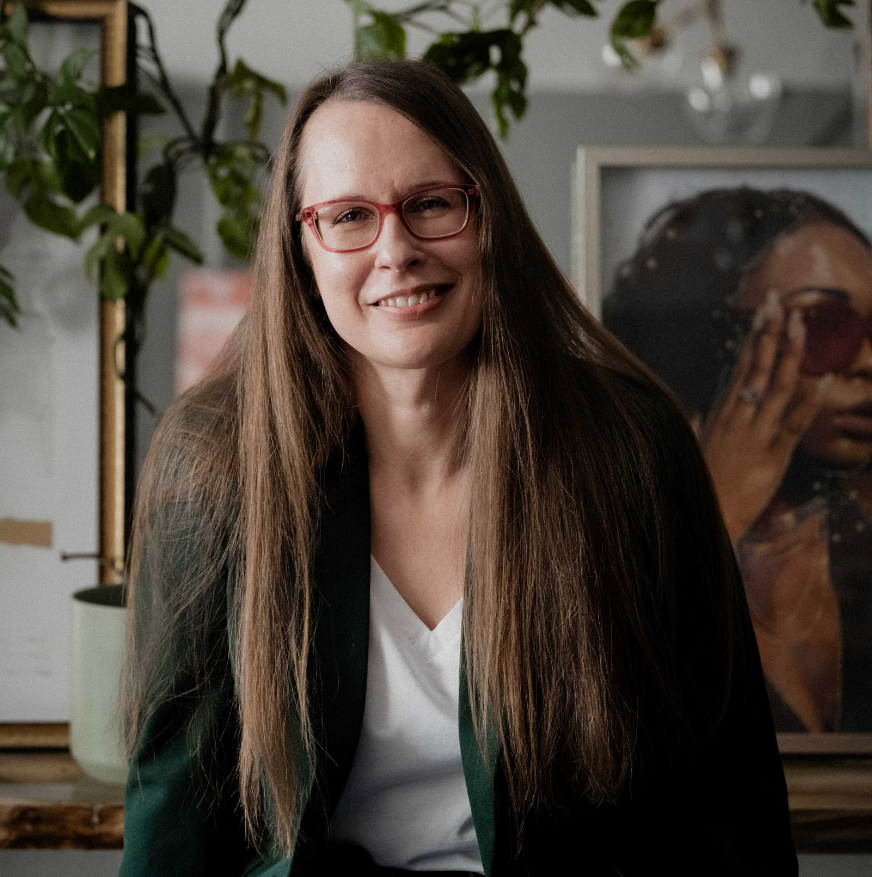
Lynda Williams
Lynda Williams is a short fiction writer based in Calgary/Treaty 7 Territory. Her work engages with themes of class, feminism, and mental illness. She describes her flavour as If-Raymond-Carver-Wrote-Feisty-Women. Lynda’s stories have appeared in Grain, the Humber Literary Review, oranges journal, HLR Spotlight, and on Room’s website. She has been a winner of the Edmonton Voices competition, the Reedsy Prompts Challenge, and has received honorable mentions in the Humber Literary Review’s and Room’s fiction contests. Her debut collection of stories, The Beauty and the Hell of It is forthcoming from Guernica in September.
Marina Raydun: The title The Beauty and the Hell of It suggests that life’s most meaningful moments often contain both grace and difficulty. What drew you to exploring that tension in your stories?
LW: That exploration happened quite unwittingly, and I didn’t arrive at the title for the book until after I had signed the contract with my publisher. It’s the title of the final story in the collection, which is an outlier in many ways—it’s narrated in third person, from the point of view of a man, and linked to another story in the collection. The tone of the piece is also more vulnerable and earnest than many of the others. I didn’t recognize it as my title story because I thought those things meant it wasn’t representative of the collection—I even considered leaving it out so Liam wouldn’t undermine the voices of the women—and yet the sentiment those words capture is in every story. I can’t emphasize enough that I never thought about the tension between grace and difficulty and the way they are coupled until this character had his brilliant insight about marriage (essentially that you have to keep choosing your partner over and over, which is the beauty and the hell of it). The deciding factor in making the story’s title the title of the book was a Google search. You don’t come up with a bunch of other books called The Beauty and the Hell of It.
MR: Many of the characters in this collection quietly resist expectations placed upon them. What interests you about these subtler forms of resistance?
LW: When people ask what the book is about, I tell them it’s my answer to the loveliness imperative and by that I mean the pressure we place on women to make themselves appealing to men in everything they do—be polite, don’t offend, mind your thigh gap, make room on the sidewalk, maintain an oddly hairless body etc. It’s exhausting, but it’s also socially policed (often by other women), so if you say to hell with that, you’ll be punished. Typically with names: bitch, slut, crazy. These words are part of how we control women. You don’t behave in a certain way and you get a reputation. I’m very interested in women who are compelled to resist and find themselves wrestling with the cost of that reputation. Not everyone can afford to alienate their friends and family, but there also comes a moment when you begin to wonder, can I afford not to? Sometimes subtle resistance is the most we can manage. We resist in the ways we can at a pace we can sustain. That type of resistance can be tougher to recognize, and that’s why it fascinates me.
MR: Your stories seem to focus on transitional moments in ordinary lives. What draws you to those points where something small shifts but the emotional stakes feel profound?
LW: These are the moments that haunt me in the stories I read. Raymond Carver’s “Cathedral” and Pam Houston’s “How to Talk to a Hunter” evoked that sense of a small shift occurring with high emotional stakes, and that was the type of story I wanted to emulate when I started writing. I like it when nothing changes, but nothing will ever be the same. It strikes me as very lifelike. Your life can change on a dime, and it will, and nobody will notice. I suppose I’m tethered to realism, although I do believe life is fundamentally absurd. The idea of placing one of life’s grand paradoxes in a story thrills me because someone can read it and see themselves in that moment.
MR: Themes of class, feminism, and mental illness appear throughout your work. How do these themes shape the characters and situations you choose to explore?
LW: This is absolutely a case of the writer creating characters in her own image. I consider class, feminism, and mental illness to be the trifecta of influences that sculpted my voice. I grew up on a farm, learned about double standards from a very young age, and received my first psychiatric diagnosis at the age of 15. Each of these things concerns questions and struggles with power—money, sex, health and disability—that’s the stuff I came up against before I could rightly call myself an adult. I figured for the amount of trouble those things gave me, I could get some mileage out of them in stories. I think we’re always learning and unlearning our relationship to power, and usually my characters are discovering that they have both more and less agency than they imagined.
MR: You’ve described your style as “If Raymond Carver wrote feisty women.” What aspects of Carver’s influence resonate with you, and where do you see your work diverging from that tradition?
LW: I fell in love with Carver’s biography before I even read his stories. I was studying English Lit and absolutely starving to read working class writers and behold, there he was in my Norton Anthology of American Literature. I was so excited to discover a writer who overcame the odds to succeed and didn’t write Daisy Buchanan and Jay Gatsbyesque stories. I wanted to read about the farmers, miners, and mechanics, and here was my former sawmill worker doing exactly that. I recall a quotation of his to the effect of “these are my people, I could never write down to them.” His work felt both literary and accessible to me, and that’s what I decided to reach for. I share his respect for minimalism, but a Carver story is not a Lynda story. Carver’s pacing is slower and more assured. His stories are longer. I’ve heard I might be funnier than he was, but to be fair, he didn’t set the bar very high in that department. I don’t recall reading his work and clutching my sides laughing. He delivered a sobering amount of humanity.
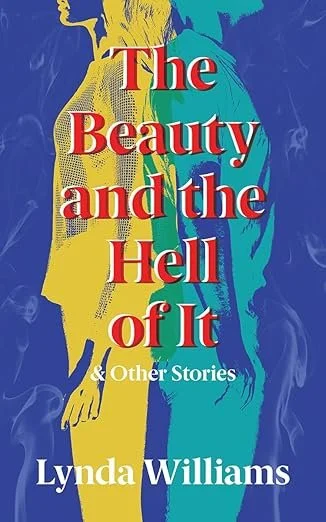
MR: For readers approaching the collection for the first time, what books or authors might you compare The Beauty and the Hell of It to?
LW: Chelsea Wakelyn’s What Remains of Elsie Jane is a delightful novel about grief and the slightly unhinged things it can make us do. I felt seen reading that book. It was recommended to me by a local bookseller after I gave a reading from my manuscript at an open mic night, and the connection was totally on point. Pam Houston’s Cowboys Are My Weakness features a cast of fierce women who are also bitingly funny, although fundamentally more outdoorsy than my characters.
MR: Short stories often capture a single emotional or psychological moment with remarkable focus. What do you find most compelling—or most challenging—about writing in this form?
LW: Poet and essayist Richard Harrison told me that characters in novels have to change, but in stories they are merely revealed. I didn’t know that when I was writing the collection. I was just interested in the moment when things change, which is altogether different from a character changing. I would say knowing this information has made it more challenging to write stories. Perhaps it’s why I’m working on a novel (based on a story no less). I’m drawn to stories most because the compression they demand is such a refreshing challenge. I don’t have to unpack things. I need to make subtext do the heavy lifting, so I’m always thinking about how to say more with less. Cutting is my favourite part of revision.
MR: Some of the stories appeared in literary journals before becoming part of this collection. When you brought them together, did any unexpected connections or themes emerge?
LW: The significance of sibling relationships in these stories caught me off guard. I didn’t plan that and I believe it comes from being geographically separated from my own siblings. They have a piece of you from a time nobody else knows, and that’s a very special thing. You don’t necessarily appreciate it when you’re around each other all the time. Thematically, I didn’t mean for the book to be so saturated in death either, but it’s also one of life’s few guarantees. I wanted my characters to confront different types of loss, so a measure of death felt inescapable.
MR: Your work has received recognition through contests and literary awards. How have those experiences shaped your confidence or approach as a writer?
LW: There’s an obscene amount of rejection that comes with writing for publication. The validation that comes from placing in contests and receiving awards is the shot in the arm that keeps you going. It’s a reminder that it’s not all for nothing. Your work resonated with someone in an important way. I need those reminders when I’m discouraged, which happens regularly. If I’m happy about an acceptance or a good review, my husband will say, I need you to make this feeling last for three months. The flip side is the pressure to keep producing “good stuff.” It’s easy to forget that it all starts with a craptastic first draft once you imagine your work has managed to achieve a certain standard. It’s easy to get in your head and question if your work is good enough to get more of that sweet award nicotine. It’s a mixed bag, but the antidote is always more writing. As long as you keep pounding away at the keyboard, you can center yourself again.
MR: When readers finish this collection, what kinds of reflections or conversations do you hope the stories might spark?
LW: I hope it encourages people to talk about mental illness and trauma, especially sexual assault, as well as domestic violence. I hope it leads to me too conversations around those things and that it helps people realize how appallingly common this stuff is. That’s the practical answer. Ultimately, I know my hopes don’t influence the meaning making process for readers, and that knowledge makes me wildly happy. What makes a passage of writing poignant for a certain person has as much to do with their lived experiences as the words on the page, and there’s a certain alchemy when those things come together. I’m always impressed by the meaning readers can take from my work. They pick up on stuff and explore it in ways I never considered and in doing so, they give life to the work.