

J.M. Shaw
J. M. Shaw is a Canadian author of fantasy fiction who lives in Alberta with her husband and two young children. She’s been writing since childhood, building worlds from raw imagination and quiet observation, but it took years before she found the courage to share them. For Shaw, storytelling has always been more than a passion. It’s a compass. A sanctuary. A way to make sense of the chaos.
In 2019, Shaw was diagnosed with autism and ADHD, a turning point that brought clarity to a lifetime of feeling “too much” or “too different.” Her intense focus, emotional depth, and ability to live inside fictional worlds became not flaws but the superpowers of a neurodivergent mind. These qualities shape her stories, infusing them with realism, heart, and meaning, and giving her the courage to finally share her creative works. Her worlds may be fantastical, but her characters—flawed, searching, and deeply human—resonate on a personal level.
When she’s not writing, Shaw enjoys connecting with nature, curling up with a good book, and dreaming up new worlds. She also finds joy in encouraging young writers to pursue their own passions.
Marina Raydun: For readers discovering the series for the first time, how would you describe The Ascension in a quick elevator pitch?
J.M. Shaw: I would describe The Ascension as a dark fantasy adventure with wholesome notes. The series is written for a young adult and up audience, so readers will find a few expletives here and there, lots of action, epic stakes, and hints of romance—with minimal physical intimacy.
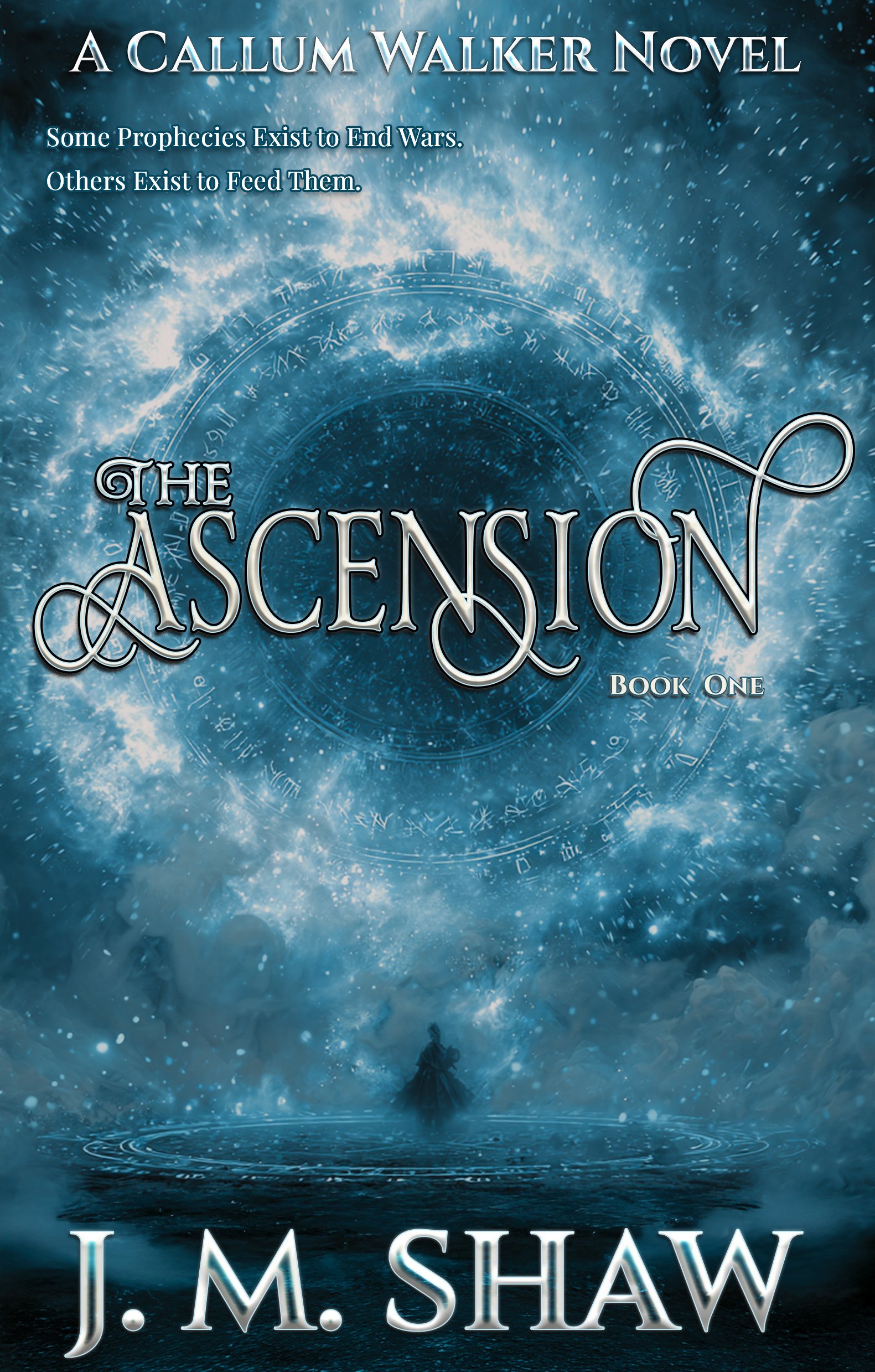
MR: This edition relaunches the book with new content and a new cover. What can returning readers expect that might surprise them?
JMS: I’ve re-edited my novel, correcting typos and grammatical errors that escaped previous rounds of scrutiny. I’ve clarified previously ambiguous points, expanded on the realm’s history, and added dialogue and character descriptions to give readers a clearer picture of the characters' appearances and personalities. I’ve also inserted a few new chapters, giving voice to key characters we follow in later books who were denied their moment in the previous edition.
MR: Callum Walker is a reluctant hero who never asked for power or prophecy. What did you enjoy most about writing a character who is thrown into destiny rather than chasing it?
JMS: I enjoyed stepping into this character’s mind and witnessing the fantastical world I’ve created through his eyes. Since I, too, feel very out of my element and confounded by everyday life, I found it easy to empathize with my protagonist as well as my other characters. This empathy allowed me to feel more deeply what I imagined Callum Walker experienced and how he would respond. Because I connected so deeply with my characters—emotionally, mentally, and cognitively—it was easy to write his authentic reactions to the many outlandish encounters throughout my story, as if I were riding shotgun on his journey.
MR: Your world includes sorcerers, necromancers, ancient factions, and a hidden magical conflict. Which part of the worldbuilding was the most fun for you to create?
JMS: I love envisioning the many places and beings throughout my magical realm. It’s easy to imagine a conventional mall or office building, but how many people get to explore a fairy village, an ominous cavern, or an elven castle? This visualization allowed me to flex my creative muscles because there were no rules or limitations to constrain my muse.
MR: If The Ascension were adapted for film or television, who would you love to see cast as Callum—or any of the major characters?
JMS: I’ve always envisioned my protagonist resembling a young Ewan McGregor. I think Ginnifer Goodwin would be perfect for my fairy, Frey, and I can imagine Zachary Quinto as my elven commander, Joric Agis. Of course, my readers might picture someone else for each of these roles. That’s the beauty of fictional writing: the words leave enough room for our minds to paint the final strokes, thus making authorship a shared endeavour.
MR: Fantasy often explores the burden of power. What kinds of moral or emotional questions were you interested in exploring through Callum’s journey?
JMS: I’ve heard it said that power corrupts, and I was keen to explore this widely held belief from a different angle. Rather than assuming someone is unscrupulous simply because they have power or abilities that the rest of us don’t, I question whether it is these endowments that degrade one’s integrity, or something else entirely. Instead of presuming that power alone is the corrupting factor, I suggested that our choices have a greater influence on our moral compass than power itself. I demonstrated this in my novel by granting my protagonist the power of magic—a mighty force that elevated him among his fellow humans—and widespread renown among those beings in my magical realm. Yet despite his gifts and fame, Callum Walker remained humble, thereby supporting my argument.
MR: You’ve spoken openly about your autism and ADHD diagnosis. In what ways, if any, do you think ADHD influences your creative process or the way you build fictional worlds?
JMS: My experiences have taught me that there is a common misconception about autism, ADHD, and creativity. I feel this stems from the prevailing belief that those on the spectrum are far too linear to think imaginatively, when in fact, the opposite is true. Because neurodivergent minds do not subscribe to conventional beliefs or societal norms, they are free to explore concepts that would otherwise be overlooked. When I was younger, I struggled to understand how people navigated the confounding domain of society. In an effort to understand the world and my place within it, I made a practice of observing, building a schematic—a living plot, if you will—to explain the how and why of life. Whenever logic eluded me, I’d invent an explanation, however outlandish, to give my observations rationale. Little did I know that my quest for knowledge was training me to become a future storyteller.
MR: You’ve been building stories and worlds since childhood. Do you remember one of the earliest fantasy ideas or characters that sparked your love of storytelling?
JMS: The first chapter book I read was The Littles by John Peterson. It was a story about a family of mouse-sized people navigating our very oversized world. Their perspective on everyday items that we take for granted was intriguing, and their unique struggles captured my interest. The story’s paradigm stirred my imagination, inspiring me to take that first step into out-of-the-box thinking. Before then, I’d seen the world differently—a beautiful creation, vivid and ever-changing—but I was encouraged by the adults in my life to curb my imagination and think logically, or what they believed was logical. After reading The Littles, I realized that I wasn’t the only one who thought differently, and I gave myself permission to venture beyond convention because, if it was acceptable for one grownup, then it was acceptable for me too. That mindset endured into adulthood because I learned to keep my musings to myself, until that fateful day I sent my manuscript for The Ascension to an editor.
MR: You also enjoy encouraging young writers. What advice would you give someone who has been quietly writing or worldbuilding but is hesitant to share their work?
JMS: I kept my work hidden for years, reluctant to share my stories for fear of what the world would think of me. It wasn’t until I finally took that step that I discovered my work had merit. Those first steps were terrifying, devoid of confidence, but I grew with each hard step, building my resolve and finding my voice along the way. As I look back on my journey, I regret only one thing: I wish I’d taken that leap years sooner. What I’m trying to say is, you’ll never know how far you can go or who you’ll reach unless you dare to try.
MR: Without giving away spoilers, what can readers look forward to next in Callum’s story and the larger magical conflict?
JMS: As we continue Callum’s journey, the first few books see him shift from a reactive to a more proactive role. My protagonist is becoming more comfortable with who and what he is, and rather than waiting for events to unfold, we will see him taking the lead in the ongoing battle between good and evil.
For more information: www.jmshawauthor.com